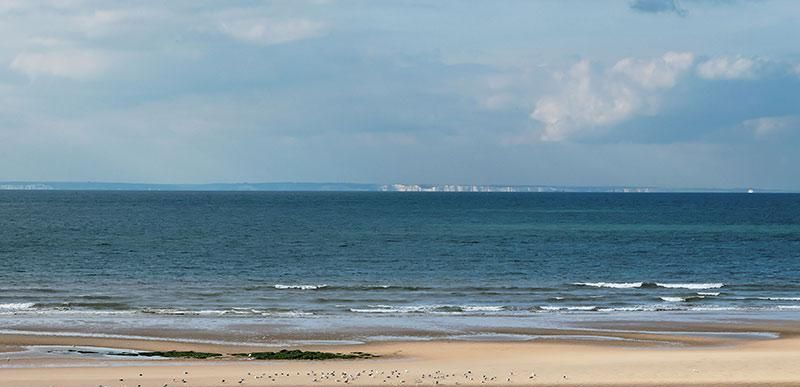
It’s the end of summer and the long beach of Calais is dotted with British tourists enjoying the last few days of their holiday. Kids build sandcastles and run around hunting for hidden treasures. A few brave swimmers splash in the shallows. Along the promenade couples swing their legs over the sand and throw chips to the gulls. On a clear day like today you can easily see all the way across the Channel to the white cliffs of Dover, gleaming in the sunlight.

But this sunny scene conceals a darker reality. Only a few kilometres away lies the overgrown remains of Calais’ infamous “Jungle”; a makeshift camp that was home to around 6,500 refugees until it was destroyed by French authorities in 2016. The number of immigrants living here has significantly declined in those years, but some of the original residents still remain. Combined with new arrivals there are currently around 500 people homeless on the outskirts of Calais and another 700 further south near Dunkirk in conditions worse than ever before. These asylum seekers live without running water or permanent shelter, their possessions are routinely confiscated and every day they face harassment and alleged abuse from a branch of French police most commonly used for riot control.
“The police come every day, take the tents, take [our] things,” says Haider, a Sudanese refugee who’s been trying to reach the UK for two years. “[They come] with…how do you say that? The bomb they come with? [Gas?] Yes gas.”
“You sleep at night and police come like that and spray with gas. I can’t sleep. It’s very difficult.”
Geographically, Calais is the closest place you can get in Europe to the United Kingdom. This fact has turned the French port into a veritable bottleneck for refugees wishing to claim asylum in England. It’s also one of the most secure checkpoints in the world, boasting carbon dioxide and heartbeat detectors, X-ray scanners, sniffer dogs, security patrols and surrounded on all sides by a barbed wire fence over four metres high.
The cost of these measures shows how determined the UK is to prevent undocumented immigration, spending millions of British taxpayer’s money on French border control. A Freedom of Information request last year revealed that between 2010 and 2016 the UK Home Office spent £316 million deterring illegal immigration in Calais and the surrounding region. This year a further £44.5 million was committed.
Despite the intense security, refugees are constantly trying to make the crossing, risking their lives by climbing inside refrigerated lorries or clinging underneath moving vehicles. Every week one or two actually make it through (Haider knows several people who’ve managed it), giving the rest hope that they might also succeed.
But for those who don’t make it, life is appalling.
Every day a branch of French police called the Compagnies Républicaines de Sécurité (CRS) armed with tear gas and pepper spray forcibly evict anyone camped in the area, destroying tents and seizing personal belongings.
Conditions are so dreadful that the question everyone who hears about the situation wants to ask is: ‘why are these people still here?’
“Everyone has their dream country,” says Ibrahim*, an unaccompanied minor from West Africa currently living rough in the Calais region. “There are Europeans who go live in Africa and stay there. It’s the same thing as us, we go to the country of our dreams.”
The refugees are aided by several charities, the largest being Help Refugees which runs a donations warehouse in Calais. Every week these charities distribute over 8000 meals and 400 blankets, as well as providing tents, sleeping bags, clothes and phone charging stations.

While they are here in solidarity with the refugees, it does seem to be a common consensus among the volunteers that seeking asylum in France would be better than trying to cross to the UK.
“I think people should claim asylum in France,” says Maddy Allen, field manager for Help Refugees in Calais. “It’s a safe country [and] certain aspects of French asylum law are far more lenient than British asylum law.”
This is something many people find hard to understand. If conditions are so terrible in Calais, why do refugees prolong their suffering when there’s a viable alternative?
There is no simple answer to this question. For some like Haider, their refugee claims have already been rejected multiple times and they are desperate for one last chance in a country like the UK where they believe they have a stronger claim. For example, last year France rejected 73% of refugee applications.
Many refugees have friends and family in the UK and some have already learned to speak English. Misinformation about claiming asylum, harsh French employment laws, lengthy processing times and poor living conditions are also key factors in the desire to cross the Channel.
But the most common reason is that almost all the people here feel mistreated and abused by the French police.
“The French do not see us as human, they treat us like animals,” a refugee recently arrived from Paris explains. It is a sentiment shared by many. Why would you want to live in a country that violates your human rights?
This is the problem that the extreme measures taken by the French and UK governments have exacerbated. By making Calais so unpleasant for the refugees the result is that nobody wants to stay, but at the same time are unable to leave.
“Calais is terrible, but Calais is not France,” says Rowan Farrell, co-founder of the volunteer-run Refugee Info Bus which provides refugees with free legal advice and WiFi. “Many of the people here have no idea what the rest of France is like. All they know is being beaten by police and rejection by locals.”
In her position as field manager Ms Allen says much of the violence towards refugees goes unreported, but it’s a different story when it comes to volunteers. In August Help Refugees and its partners released a report alleging 600 acts of police intimidation and harassment of volunteers, including 37 incidents of physical violence.
The local authority in Calais denied the allegations, but Ms Allen believes the report has resulted in increased police activity. “Pre the report […] there were around seven evictions in a week,” she said. “In the eight days following that report there were 16 clearances.”
But the refugees refuse to give up. As an anonymous CRS officer told French newspaper Ebdo Journal: “As long as the land of England is over the border from Calais there will still be migrants here. Even without blankets and water. Politicians are trying to deter them from coming, but that’s not going to happen. Maybe it’d disgust someone unconvinced and undetermined – but it won’t deter these people. They are coming from war-torn countries, from dictatorships, from countries with big economic or climate change issues. They left their families behind, walked for thousands of kilometres in difficult conditions, and have been left in the hands of the mafia.”
Ibrahim confirms this determination.
“It’s difficult but we have gone through lots of suffering so we don’t have a choice,” he says. “We want to go to England. If [we didn’t] we wouldn’t be here.”
So far nobody has managed to solve this stalemate. The best solution according to Mr Farrell might be to open a UK “asylum centre” here in Calais where refugees can claim asylum without having to physically cross the Channel. This would remove the dangerous journey but still allow people with valid claims to reach the UK.
However a similar proposal in 2016 was firmly rejected by the UK Home Secretary and French authorities have similarly voiced their resistance to the idea. Although she refused to provide a comment for this article the mayor of Calais, Nathalie Bouchart, has previously said she was personally opposed to humanitarian efforts in the region.
With no solution in sight, the situation is worsening for those still living in the area.
“It’s not sustainable,” says Ms Allen. “The current operation is hugely expensive [and] a lot of that is due to the increase in intensity of police violence. Pre-Jungle if we were to give a tent out it would last four to six months, now a tent will last less than four days.”
When asked what he would like to say to the readers of this story, Haider pauses for a moment to think.
“I would ask them to help,” he says eventually. “I would ask for help from someone in England to come here and help. Help me so I can go to England.”
Back on the beach the kids play, waving at the passengers lining the rail of the day’s last ferry as the sun sinks into the sea. The old residents of the Jungle and those who’ve just arrived prepare for another long, uncertain night. Maybe tomorrow things will be different. Maybe tomorrow they will reach the country of their dreams.
Maybe tomorrow.
*not his real name
 Damon Meredith
One thought on “The View from Calais”